The world outside was vibrating, but from the 150th floor I couldn’t hear a single sound of it through the triple-thick 25mm laminated architectural quartz plates, reinforced for sun, wind, and any other physical bodies that could fly at phenomenal speeds through the air channels and vertical travel lanes 10 meters from my window.
The coffee this morning was excellent, the water chemistry was finally just right, and after weeks of micro-adjustments my mug felt like it could have swallowed me up into it and I could tuck into the clouds of microfoam and silk for just a few hours more of rest. I stared at the overlay of my reflection on the outside world, thinking about my trip, and what made this one particularly special this year.
“Alphie, what time is it?”
“It’s 0847 hours. We need to leave in 20.”
“Thanks, buddy,” I said defeatedly, already feeling beat by the day. “Let me know when we’re 5 minutes out from departure.”
When I upgraded my AlpheccaAI Communication Companion to the modern standard decades ago, I couldn’t bring myself to completely part with Alphie, always skittering at my feet, never in the way. On nights I can’t sleep, Alphie still comes close, belly glowing golden, warm and soft, emitting the sounds of his digital processing unit, mimicking the chattering murmurs of birds rustling through leaf litter. His black bobbling telemetry input reminds me of the quail that I used to compete with while foraging for blackberries in the Great Republic of California.
The day has started early, but I know I'm going to have plenty of time to sleep on the job. Alphie has been extra gentle and accommodating this morning, having yottabytes of exosomatic microsecond-scaled snapshot memories of me stored onboard.
“Ready to lock up, Aster? We’re 5 minutes out.”
I silently nod, and Alphie responds with a subtle puff, the wafer-thin anodized platinum leaf mail tinkling gently against his underlying solid chassis. The apartment shuts down except for the safety illuminators, and the temperature drops instantly. Alphie waits by the door as I grab my packs, and together we move into the hallway, Alphie’s aerofoil silently keeping him afloat, while my techboots seem to weigh just an ounce or two more on this particular morning as they loudly graze the self-sterilizing mesh of the public corridor floor. As we move through the angular corridor, engineered for the thousands of residents tucked away behind the adjacent apartment doors, I already miss my view out my window onto the world here on earth. As quickly as that pulsed feeling of loss beats through me, my brain switches and locks in. Several strides down the corridor bring us to a slick metal circle set flush into the center of the hall.
Alphie doesn't wait for a prompt; his chest pulses amber for one second as he concurrently confirms my biometric readiness and interfaces with the building hatch.
The whoosh of air up through the hatch seams brings with it the crystalline enclosure that encapsulates us, and before I have time to settle my weight, the tiles of the hatch fold outward and disappear, like dominoes falling away into the floor. We drop 75 feet straight down through the structural core of the building, sliding smoothly until the pod seats itself with a gentle, measured, and precisely dampened landing, directly into the roof intake of our waiting transport. There’s no stepping out, no unbuckling, and no wasted motion. The pod locks us flush into the transport’s passenger bay, and almost in the same instant we click down, we are rushed out into the cacophony of air traffic at level 75.
“We’re early, Aster, look at us!”
Without looking at him, I knowingly smile and poke my finger into his delicate armored feathers. Even Alphie has adopted, accepted, and adapted to my reputation for getting to the transport just in time for boarding. Just the two of us in the transport is comforting, as the air traffic whizzes and whorls around us silently. The motor drive hums rhythmically with our changes in altitude as we weave and glide through traffic.
For eleven months of the year, I‘m grounded, training, staying physically strong, and studying the blueprints of obsolete machinery. Then, once a year, I test, prep, stock, and (wo)man A Dart-Class Deep-Atmosphere Utility Hauler and head out to one of earth’s 15 inter-galaxy waypoints to service sensor arrays three times my age. A single 6-week stint leaves me mostly working-from-glass tower the rest of the year.
The air traffic swarms in all directions while I gaze out of the main viewport. I think about what it would have been like if the old panic during the initial AI boom had actually broken humanity instead of forcing us to evolve. If the historical shift had not taken place, I could have ended up at some terrestrial desk job, hashing and wrangling network nodes all day instead of stepping through the tetrahedral folds of space on a regular route. The collapse of the early AI revolution paved the way for progress, which places me square in this moment. The world figured out how to bend the universe into something practical, and collapse light-years of dead space into a manageable, folded shortcut for space travel.
We arrive and de-board our transport directly into my sector’s massive hangar and have about a quarter mile walk to the ship. Alphie begins our oral pre-flight checks with me, and just as I verbally acknowledge our destination (that we’ve been planning against for 11 months, but, sure, let’s be thorough), Alphie pings for my dad’s status and confirms he’s right where he said he’d be for our call.
"Sir, your daughter is securing her helmet. I will run background diagnostic safety checks, otherwise the line is all yours."
Alphie starts pulsing blue from his head down his back, and zooms several feet ahead of me to serve as our field marker through the hangar lanes, while I wrestle my helmet over my wild head of curls. Alphie guides us along the pilot path, beacon flashing ahead of me, and as I seat my helmet into my jumpsuit collar, the hangar roar instantly cuts out, and my head feels like it’s in a cloud, all outside noise cancelled. I see if dad’s online:
"Hellooooo?"
"Hang on, hang on, juuuuust a second....."
"Juuuuussst....................Hang............On........"
"...............................hnnnngh—"
"Ackkkkk!"
Every time. Every. Damn time. I smile and chortle to myself, because bearing witness to this moment of frustration for my dad feels like hugs and home to me. Finally, the audio snaps clear:
"THERE’S TOO MUCH TECHNOLOGY!"
"Aww, you don’t really mean that, Dad."
"No, you’re right. I don’t," he sighs out, instantly both calm and exasperated. Without skipping a beat: "So, going to work today?"
"Yes. I’ll be back at the end of next month. Alphie sent Mom the touchdown date window."
"NexT MonTh?!?! Well then Mom has to reschedule my Diamond Jubilee!"
"She already did, Dad! And I’ll be there! Besides, on your ACTUAL birthday, I’ll still technically get to see you even if you don’t see me. So.... I guess.... I’ll see you 75 years ago, and you’ll see me next month!"
Long before the AI stabilization era, back when the first wave of deep-space expansion pushed out toward the outer perimeters, corporations launched thousands of rugged, but really dumb sensor arrays with hard-coded analog controls and heavy-duty mechanical relays out into space. As they have aged, their existence has proven invaluable, and companies have a vested interest in keeping them online and operating. This presents a unique type of problem for today: An AI agent can calculate the trajectory to get there, but once on-site, you need hands with opposable thumbs, a soldering iron, a multimeter, and a deep understanding of physical systems to open the hatch, identify fried analog circuits, and splice in a modern upgrade module.
When a multi-billion-dollar corporate relay station goes dark at the edge of the perimeter, the autonomous drones and AI systems just stare at it like an ancient alien artifact. Which, to be fair, it is. They can't talk to it, they can't rewrite its code remotely, and they can't physically turn a wrench.
So, they call in the humans.
"Okayyy, well, have big fun! I’M SO JEALOUS!" Dad’s voice booms back through the link in my helmet.
"I know! And I will! Alphie is going to transmit to Mom’s console like last year, so you guys can look at the images on the big screen. That worked well, right?"
"Oh yeah, and Mom will love that. She loves how helpful Alphie is. I don’t know why."
I can feel the look of disdain my father is likely shooting at Plenum and Loop, the resident ccAI’s belonging to my parents.
"I love Alphie! Everyone loves Alphie! Mom loves Alphie because he leaves digital feathers for her," I tease, glancing forward at Alphie’s brilliant blue-hued beacon as he glides toward our hangar bay.
Dad booms back in my head, "Yeahhhhhhhh whatever. Tell Alphie his ping sequence handshake is unencrypted and out of date. It drives "The Help" nuts every time they sync. Tell your space chicken to get with it and update his protocols before I have Plenum and Loop suck the digital life out of him."
Before Alphie can pipe up in my helmet and defend himself, Mom’s voice bleeds faintly into the background feed from across their livingroom. Muffled, gentle, but carrying that unmistakable protective steel, and in jest:
"Loop would NEVER!"
"See? She loves these stupid things," Dad calls out.
I hear Mom step closer to his audio pickup, her voice clearing up just enough to register her staunch defense: "Loop would never! Not to sweet Alphie!"
I grin, and promise Dad I’ll have Alphie look at our handshake protocols during deceleration home.
"Alright, alright, time for my walk. Have big fun. Love you bunches!"
"Love you too, LOVE YOU MOM!"
Legacy Systems Telemetry and Recovery Specialist ships are shared on rotation, and just my luck, this trip I am provisioned to my favorite one: The Faria. She is an absolute beauty. Built for dual-environment operations, her nose is sleek and hyper-pointed to slice cleanly through atmospheric entry, but under all that shiny exterior she’s packed with rugged, industrial-grade utility frames for heavy cargo. The Faria is the shape of a folded paper airplane, dipped and polished to a high mirror-shine that makes her stand out against the absolute blackness of the void. She's perfect for quietly carving our way through the folds of time and space to reach these forgotten space relics. I am one of four L-STARS operating out of my region, and probably one of the brightest ;-)
The hangar is quiet this morning, and as Alphie gets all the hatches open for my visual inspection, I wander to the nearest kiosk. I punch in an order for coffee with heavy cream, along with an order to send Alphie the latest AI model training games for our ride out. Sometimes the training games require a human-in-the-loop, but most people think it’s a waste of time since ccAI’s are completely autonomous. But Alphie and I, we like to train together.
I grab my cup and walk up the main hatch and heave myself in, coffee in hand. I grab the lockout pin on my way through, and the hatch closes behind me with a dull clank then seats itself into the outer seal. Alphie glides to the main console and meets me there.
“We’ve got some work to do, Alphie...” I say slyly and wryly as I poke my finger into his plumage again.
It’s a funny thing to want to please a ccAI. And even more peculiar to see how naturally they mimic life. His platinum plumage chimes softly as he accepts the data payload from the station kiosk, puffing up satisfyingly as soon as the download is complete. It’s a quaint little quirk, looking for all the world like an idle ground bird settling down to preen under the shade of a big oak tree.
Alphie is stoked on my ML training game selections.
As my coffee cup hits the console, I drop into my seat and the full bleed flight display flickers to life and erases the bulkhead entirely, wrapping the cockpit in a super-saturated, terrifyingly sharp panorama of the exit bay. The curved edges give the illusion that the entire control deck is hanging on an infinite cliff. Alphie docks directly into the concave console to my left, his posture sinking as the linking lattice pattern of his metallic feathers seals tight into a protective shell and glows a deep, steady red. It’s an unmistakable visual cue that he’s gone into low-power mode to run some internal digital clean-up of his own while I review our itinerary. (Once again, an itinerary we’ve been planning against for eleven months, but, sure, let’s be thorough). For our exit from the hangar, I am momentarily alone with my thoughts, and completely in the care of the Faria and the agents running her.
It takes an enormous amount of thrust to get up and out of the atmosphere, and for the ship to survive, The combustion chambers and throat of the main drive are lined with Rhenium. It's the heavy, expensive element that keeps the thrusters from melting into radioactive slag when the ship redlines its thermal limits during a long burn.
I receive the go-ahead from the control deck, which is really just a bunch of autonimous supervisory AI agents running around in physical robot chassis. Apparently humanity never quite got over the unease of a completely empty, agent-run control tower. The droids are theater, giving the illusion of "someone at the wheel" with a metal body and a set of eyes. An innecessary hardware maintenance headache, if you ask me. Once I’m clear, Alphie wakes up, spinning up his operating mode LEDs in a slow, alternating rhythm of amber and blue that mimics breathing. I turn back to the console. The moment my eyes hit the glass, The Faria surges to life, roaring out of the hangar bay and into the open sky. With a crushing G-force that pins me deep into my harness, we clear the gravity well and punch straight through the upper stratosphere.
For the next few weeks, the transit is just the low, thrumming heartbeat of the life-support systems, the smell of recycled air and dark-roast coffee, and the quiet rhythm of cooperative diagnostics with Alphie. We spend hours running through data models and calibration scripts as a shared choreography between human and machine, a way to keep our spatial awareness sharp while the void slips past the viewport.
To safely fold time and step cleanly down through the tetrahedral folds of space, home base requires us to pass a certain distance from earth before engaging the sequence. On day 5, the ship begins to wake in sequences, signalling its prep for our stairmaster workout. How The Faria is able to generate a palpable tension and anticipation in the air is beyond me, but I feel it, and Alphie notices, too.
“Aster, let’s go secure the terminals and send a message back home before the jump. Mom has pinged 4 times since we left to see where we are.”
“I should. I will. Can you set up the link for me, I’m going to go secure my packs and grab snacks.”
As I return to my seat, bag of snacks and cold beverage in hand, I quickly dictate a message home to Alphie and I can tell he’s buffering my message and not sending it real-time like usual.
“Aster, my digital signature is out of date. I have to send it unencrypted. I’ll shoot it over to Loop. Plen’s been particularly difficult recently. I’ll send him a diagnostic after your message. He probably doesn’t know he’s rejecting half my handshake requests.”
I wince.
I pause.
But then...... I authorize it.
I finish up securing all my personal cargo and buckle in to my pilot seat. We hold a steady course and begin to backburn and decelerate over the course of an hour, until we come to a near stop at our jump off coordinates. The transition feels like a ramp up, thrusters turning up to maximum output at the same moment the ship lurches then grinds forward, but with the sensation that we’re decelerating. In reality, we are punching through the folded coordinates with minimal friction, moving faster and harder through the folds. The deeper we get, the closer we get to our destination coordinates. At the same time, the more friction we encounter, the more I perceive it as traveling backwards. It takes only a quarter of an hour, but when the grinding lets up and we lurch to a stop, we’re caught on the other side, soft like a lobbed softball into a catchers mit. We backburn to bring us to a normal clip, dropping out of the fold at our destination perimeter.
“Alphie, start image capture. Let’s get those serial numbers sent back ASAP, that doesn’t look like the drawings they gave us.”
The ancient relay station looms before us, tethered to a massive solar panel only by the cable running from the panel to the charge controller input of the station. They sure loved hard-wiring these components back in the day. I foresee some welding in my future. Good thing I made my own spares list. I’ve been out here enough times to know that I can’t fully rely on the information I’m given. I have to prepare for the repairs they say will never be needed. Well, here we are, the solar panel mount weld failed after 100 years. Go figure.
The next few days blur into organized chaos and deep focus inside The Faria’s cargo hold. My workshop is a tangle of tools, stripped wiring harnesses, and bins of sorted parts I’ve held onto “just in case”. I spent two days working outside the ship, retrieving modules off of the telemetry array and evaluating whether it’s even repairable. I decide to give it a fighting chance, and pull several major components from the behemoth into my ship. Over at my lab bench, solenoids clamp shut with sharp metallic snaps in succession in the testing chambers, cooling fans whir white noise and buzz as they oscillate and variate in speed, and status lights flash amber and green across the bench outputs as I run the ancient analog sensors through calibration sequences. I am an archaeologist of engineering, knee-deep in electronics and decades-old solder, breathing what life I can back into this dinosaur.
Alphie hangs with me most of the time. I consult him a lot, because I know a little bit about a lot of things, which is why this job is perfect for us. Alphie’s got the details, and I understand them, I just don’t always remember them. He also reminds me of the time, although up here, the lack of schedule and circadian cues lets me work on my own rhythm and cadence. I can go for 9 hours, nap, have a snack, and keep working or take a break and read or play training games with Alphie. Not having a schedule, but always having the time feels like a luxury.
It’s been a long repair session, and by the time I feel like I’m at a good stopping point and all the tests are set to run for the next 12 hours, I straighten up, wipe my brow, and call a hard stop. I glance at my timepieces, a custom display unit I built to keep track of four precise times: Local earth time at home, elapsed earth time of my trip, elapsed relative time of my trip, and most importantly for this ride, a countdown clock to August 8, relative to my position, 75 light years from earth.
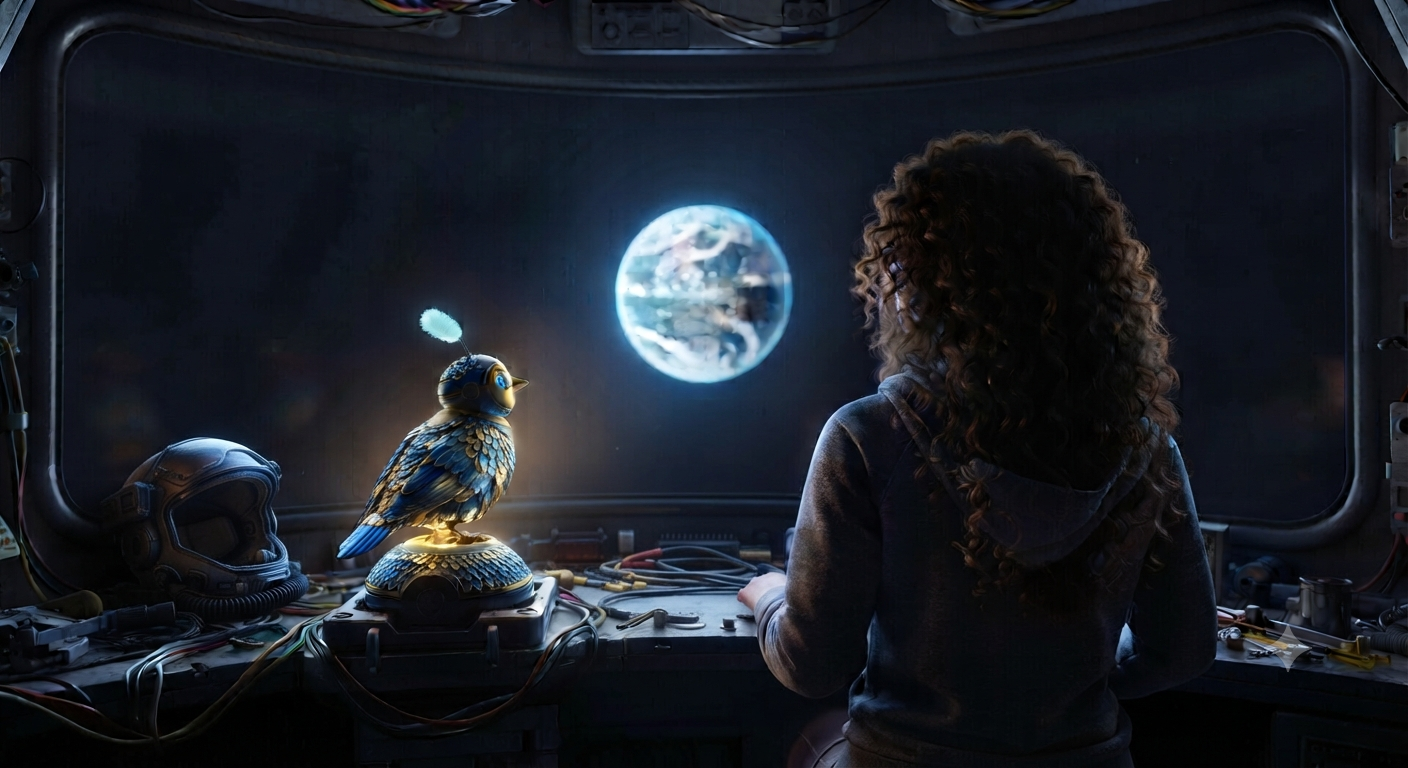
I grab lunch from the cargo hold and shake the silver pack to activate the heat element in the lining. It’s chili today, and I instantly think of our family joke, mom making chili on the hottest day in summertime. I smile and think about all the work she’s putting into dad’s birthday party this year. I carry my bag of soup back up to the cockpit, and settle into my pilot seat. Alphie passes by his console dock next to me and instead drifts over to my left shoulder with a soft, inquiring tinkle of feathers, just as I punch a series of commands into the navigation suite, orienting The Faria's long-range optical arrays directly back toward earth. As we reorient, I shovel some space gruel into my mouth. It tastes surprisingly satisfying, and I get comfy in my pilot seat.
Earth comes into view, slowly walking its way across the display, Magnified across the vast expanse of deep space. It’s quite a wonder to witness and I never get tired of this view, either. I set my spoon down for a second, taking in the expanse and stillness of space and just look upon the earth, my home. I keep one eye on my custom clock as I continue scarfing down my space meal. I might treat myself to another after the show coming up in a few minutes.
This year’s trip aligned with two things: ideal space weather to travel the folds to this particular station which happens to be the furthest we know of from earth. And, by the calculations I’ve worked on over the last few months, perfectly coincides with one of the most important days of the year. Seventy-five years ago today, my dad was born on that planet im softly gazing at from my ship. And the light carrying the image of that exact day, the ambient photon echo of his first breath, has been racing across the cosmos every second of my life. I’m meeting that echo in just one moment, right here, right now, at the absolute edge of human space.
Floating here in the purest vacuum silence of space, surrounded by dead iron and ancient tech, I realize how deeply connected we are to the fabric of the universe and one another. The tiny bits of what make me me- my grit and perseverance, a love for fixing and solving, the quiet laughter over a ruined ping sequence- were spinning into existence in the moments I’m experiencing right now, 75 light- years from earth on August 8th.
I scrape out the last bits of my lunch from the silver bag and plunk my spoon into the bottom. Alphie softly chimes a warm, comforting note beside me, and together, we sit in the dark and watch the history of the world, and my family, shine back at us.